Nobel Creations 2025 at the Nobel Prize Museum – 5 December 2025
Fashion creations inspired by this year’s Nobel Prizes
This year’s edition of the Nobel Creations exhibition, presented in collaboration with the Nobel Prize Museum, is now open.
The exhibition is open from 5 December to 4 January 2026 at the Nobel Prize Museum in Stockholm’s Old Town. Listen to Swedish Radio programme Stil i P1’s report from the exhibition here.
In the Nobel Creations project, first-year Fashion students create their own interpretations of the Nobel Prizes in Physics, Chemistry, Physiology or Medicine, Literature and Peace, as well as the Sveriges Riksbank Prize in Economic Sciences in Memory of Alfred Nobel.
The creations explore what Nobel laureates, artists and designers have in common: creativity—the courage to think differently, challenge established theories and combine insights from different fields in new ways. They also offer a fresh take on formalwear, showing how fashion design can express a sense of occasion, celebration and dignity.
Fashion photograph by Carl Bengtsson
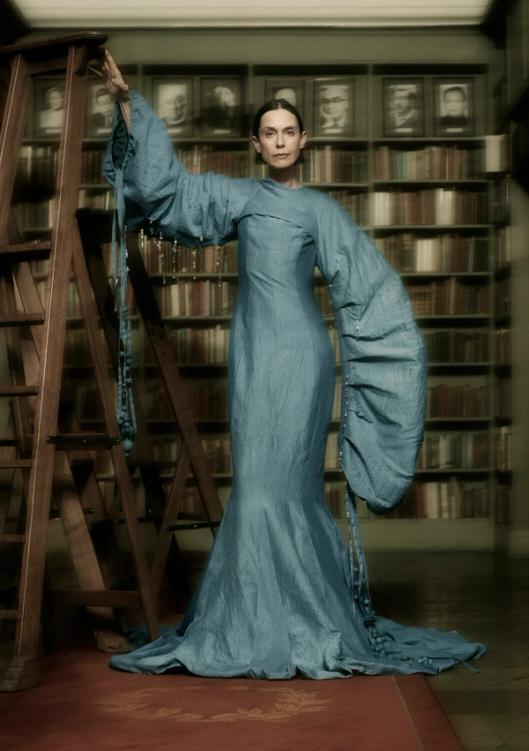
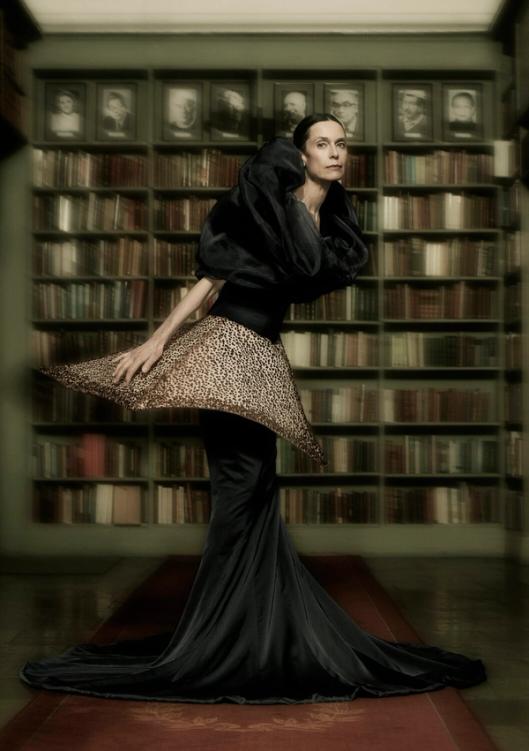
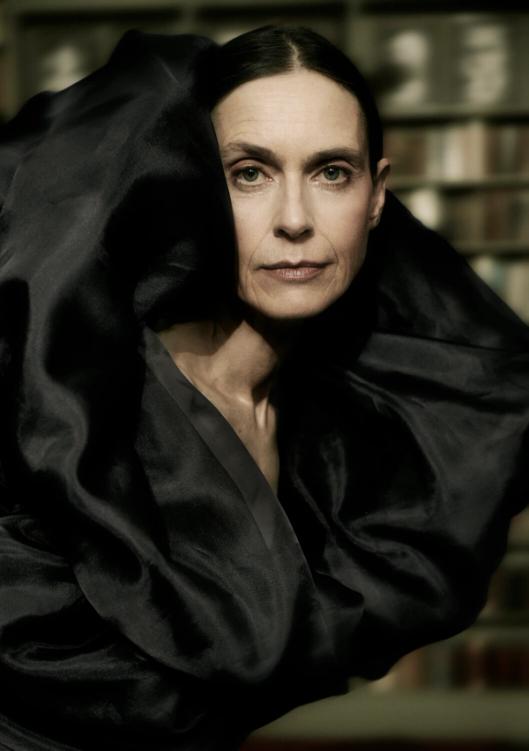
This year’s six creations were photographed in the Swedish Academy’s Nobel Library by fashion and portrait photographer Carl Bengtsson.
Photography assistant: Jakob Sandell
Hair and make-up: Helena Borg
Model: Anna Juvander, Mikas
How can a Nobel Prize be interpreted through fashion?
Discover this year’s six creations and how the students have interpreted each award.
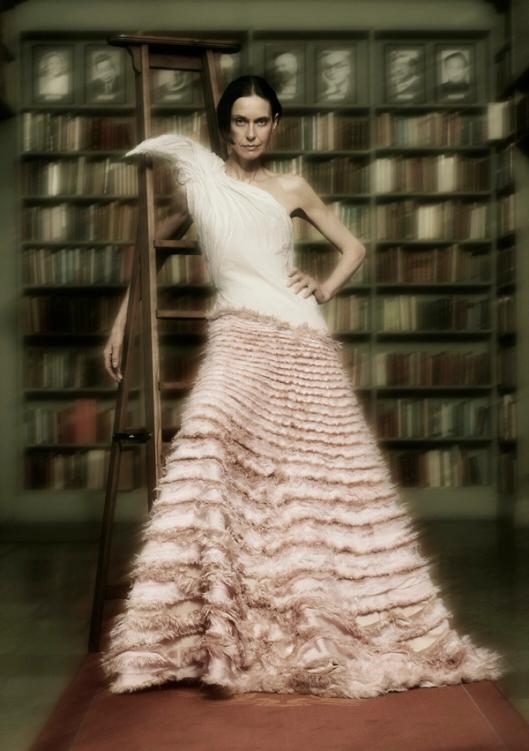
Peace – “Zenaida auriculata” interpreted by Johan Peralta and Zuzanna Mieczkowska
Nobel Peace Prize The 2025 Nobel Peace Prize is awarded to Venezuelan opposition politician María Corina Machado for her fight for democracy.
“This dress symbolises the transition from dictatorship to democracy. The lower section is defined by irregular cuts that reflect chaos, control and suppressed freedom. The structure gradually settles at the waist, giving way to a smooth, harmonious surface—a movement towards peace and balance. At the neckline, the draping forms the silhouette of the eared dove (Zenaida auriculata), a symbol of hope and freedom. The dress tells a story of the journey from oppression to liberation, from darkness to light.”
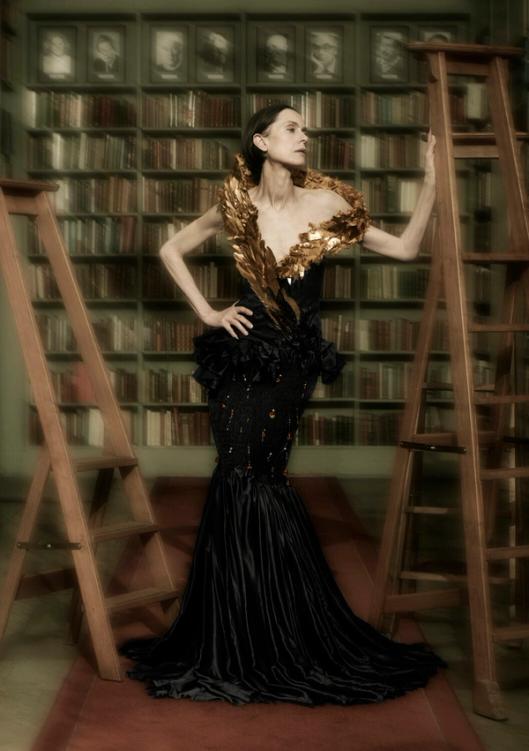
Economics – “Creative Destruction” interpreted by Johanna Strand and Allada Wärdell
The 2025 Prize in Economic Sciences is awarded to Joel Mokyr, Philippe Aghion and Peter Howitt, who visualise progress as established structures are reshaped.
“The skirt spreads across the ground like an ageing system. The silhouette narrows into a smocked section, representing a phase in which resources, ideas and energy are gathered and restructured. The bodice evolves into a phoenix with feather detailing, expressing rebirth. As a whole, the piece shows renewal as a gradual process: first breakdown, then concentration, and finally transformation towards a new direction. The dress becomes a tangible interpretation of growth through transformation.”
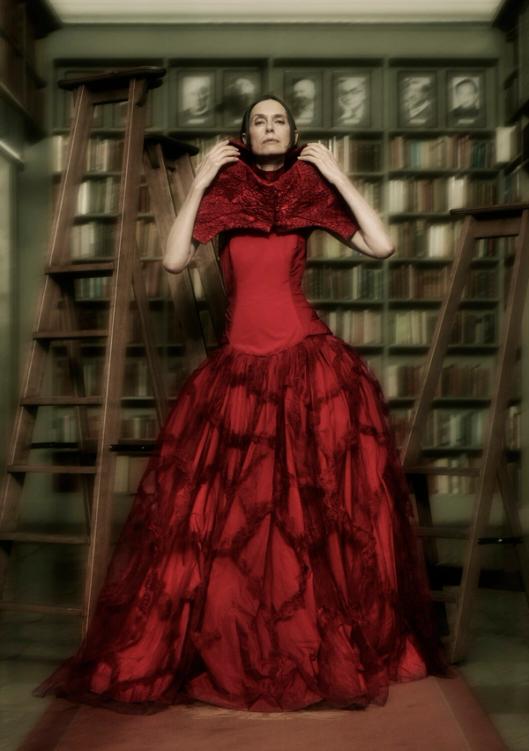
Medicine – “YoU”, interpreted by Odessa Calloway and Lovisa Schmidt
This year’s Nobel Prize in Physiology or Medicine is awarded to researchers Mary Brunkow, Shimon Sakaguchi and Fred Ramsdell for their groundbreaking discoveries concerning peripheral immune tolerance, which prevents the immune system from damaging the body.
“Within the body’s inner landscape, the movements of life flow. Our design brings together science, emotion, structure and rhythm. At the heart of the work, a rising sun burns brightly. Together with the T cell—the body’s guardian—it becomes a symbol of hope: a new chance and a story of a better life. The shifting surfaces evoke a living function in constant transformation. The life within emerges and becomes visible.”
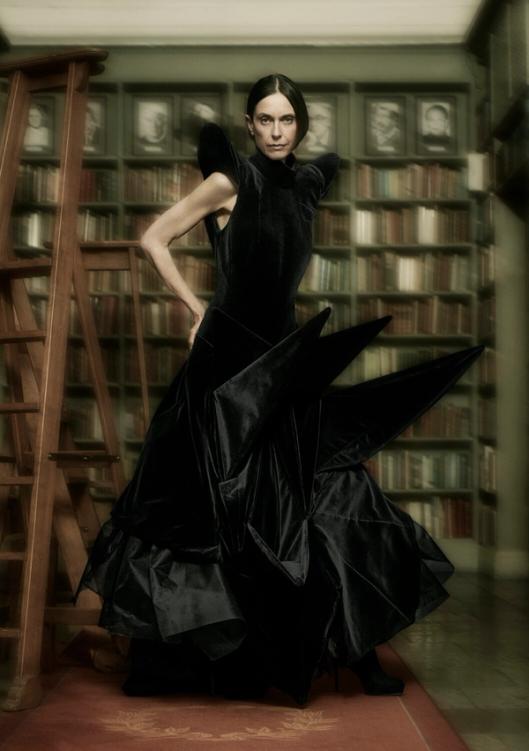
Literature – “Eclipse”, interpreted by Charlie Hoffmann and Mustafa Husseini
This year’s Nobel Prize in Literature is awarded to László Krasznahorkai “for his compelling and visionary oeuvre that, in the midst of apocalyptic terror, reaffirms the power of art.”
“A sculptural interpretation: a body poised between order and collapse, an origami form like the crystallised remnant of a lost civilisation, stillness within movement. Sharp points bear traces of time and resistance, the fabric suspended between falling and salvation; black velvet shapes a silhouette of human resilience in the poetic ruin where thought and matter meet—a garment waiting.”
Physics – “A State of Confinement”, interpreted by Linnea Bergsten and Tobias Börjesson
The 2025 Nobel Prize in Physics is awarded to John Clarke, Michel H. Devoret and John M. Martinis “for the discovery of macroscopic quantum mechanical tunnelling and energy quantisation in an electric circuit.”
“The creation depicts atoms randomly distributed within a cloud of probability. We worked with rounded volumes at different scales, from micro to macro. The garment has a form of its own, independent of the body, creating a sense of confinement. The silhouette evokes an enclosed formation, as though the wearer were behind a barrier. Like a quantum phenomenon, cascades of beads escape through tunnelling.”
Chemistry – Julian Dahlberg and Sultan Mosawi interpret “Metamorphosis”
The Nobel Prize in Chemistry is awarded to Susumu Kitagawa, Richard Robson and Omar M. Yaghi for the development of metal–organic frameworks (MOFs)—materials in which metal ions and organic molecules are linked to form crystals with vast internal spaces.
“The silhouette embodies an ongoing transformation—a process in which gas becomes liquid as it passes through the diamond structure’s large cavities. The result is a new, refined form. Shimmering copper tones evoke the presence and energy of metal ions. A framework captures the meeting point between the sculptural and the organic: a physical and symbolic metamorphosis that reminds us of the eternal cycle of change.”