Nobel Creations 2024 at the Nobel Prize Museum – 7 December 2024
We’re celebrating the Nobel Prize with the opening of the Nobel Creations exhibition!
Creative interpretations of this year’s Nobel Prizes
In the Nobel Creations project, first-year Fashion students create their own interpretations of the Nobel Prizes in Physics, Chemistry, Physiology or Medicine, Literature and Peace, as well as the Sveriges Riksbank Prize in Economic Sciences in Memory of Alfred Nobel.
The works explore what Nobel Prize laureates, artists and creatives have in common: creativity—the courage to think differently, challenge established theories and combine insights from different fields in new ways.
The creations also offer a fresh take on formalwear, exploring how fashion design can express special occasions, celebration and dignity.
Fashion photograph by Carl Bengtsson
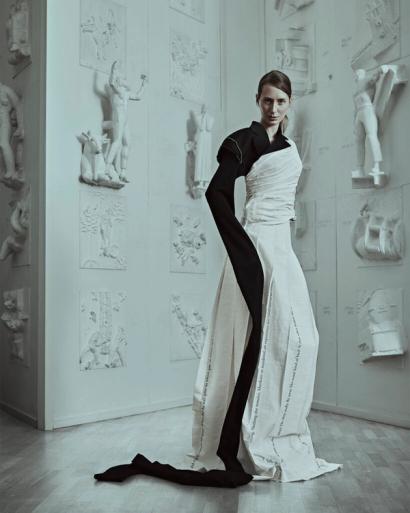
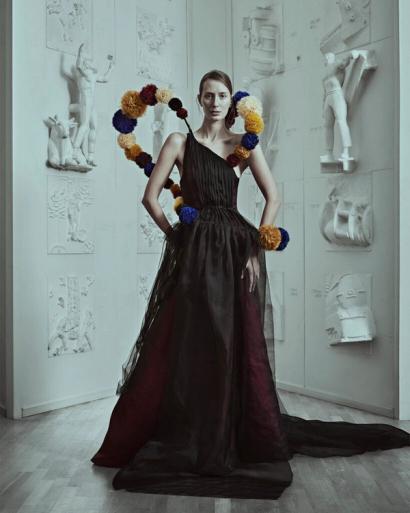
This year’s six creations were photographed at Millesgården by fashion and portrait photographer Carl Bengtsson.
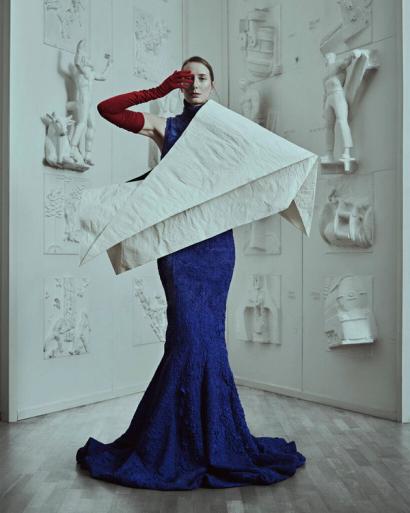
Peace – “Tranan” interpreted by Clara Samor, Edit Hulting and Theo Sternehäll
The 2024 Nobel Peace Prize is awarded to the Japanese grassroots movement Nihon Hidankyo for its work towards a world free of nuclear weapons.
“We are inspired by the way Nihon Hidankyo amplifies the voices of ‘ordinary people’ and brings an important message to the public, both locally and internationally. In creating this piece, we explored traditional Japanese craft techniques, focusing on the manipulation of materials. It consists of a nuno-felted dress and a cotton top that evokes folded paper. The dress symbolises the grassroots movement—roots growing from the ground and carrying a message. The roots meet the folded paper, an abstract interpretation of the origami crane, an international symbol of peace. In the spirit of Nihon Hidankyo, the work seeks to bring a historical event into focus and make it relevant today.”
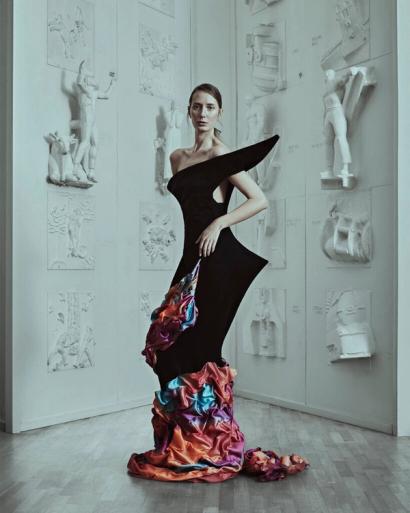
The Sveriges Riksbank Prize in Economic Sciences in Memory of Alfred Nobel – “Authority and Movement”, interpreted by Nadja Olsson and Luis Brunet
The 2024 Prize in Economic Sciences is awarded to Daron Acemoglu, Simon Johnson and James Robinson for their research into how institutions shape the prosperity of nations.
“We contrast power, strength and authority with warmth, life and joy. Our work reflects a future in which positive change takes place within institutions, leading in turn to economic growth. An opaque structure with a bold, powerful and rigid silhouette represents the power held by institutions. This is contrasted with a vibrant, colourful spiral symbolising humanity moving towards a life free from poverty. The floating mask embodies anonymity, collective strength and a shared longing for freedom.”
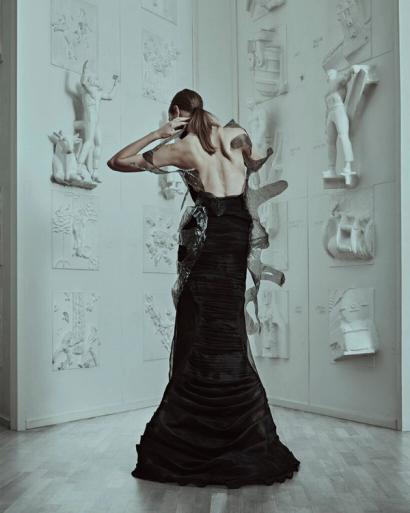
The Nobel Prize in Physiology or Medicine – “Codice Vita”, interpreted by John Ölén and Jacob Borgenstierna Ploski
This year’s Nobel Prize in Physiology or Medicine was awarded to researchers Victor Ambros and Gary Ruvkun for their discovery of the fundamental principle governing the role of microRNA in gene regulation.
“We chose to celebrate this small configuration of microRNA molecules by transforming its comb-like structure into a sweeping organza ribbon. Its transparent resin coating embraces the close-fitting dress in an organic movement. To further emphasise the structure, form and movement of microRNA, we worked with a monochrome palette. To give the piece greater depth, we created panels of pleated silk organza as a tribute to DNA and its familiar double helix.”
The Nobel Prize in Physics – “Associations Connected by Memories”, interpreted by Emil Biering and Mia Ekström
The 2024 Nobel Prize in Physics was awarded to John J. Hopfield and Geoffrey E. Hinton “for foundational discoveries and inventions that enable machine learning with artificial neural networks”.
“Our creation is a controlled organic network set against a minimalist backdrop inspired by neural connections and the complex structures of AI. Neurons in vibrant colours flow from head to toe, symbolising innovation and the future. Light reflected by the beads evokes energy travelling through the nervous system, creating a rhythm that draws the eye along the patterns across the wearer’s body. Through our intricate wrapping technique, history, science and aesthetics come together in a distinctive tribute to human creativity and technological progress. It celebrates the interplay between humanity and science, with every layer of our creation expressing the beauty of the neuron and the power of AI.”
The Nobel Prize in Literature – “The Hidden in the Colour of Sorrow”, interpreted by Adrian Musa and Johannes Söderbäck Kirksaether
This year’s Nobel Prize in Literature was awarded to the controversial and experimental Korean author Han Kang. Through her poetic, contemporary prose, she lays bare human vulnerability, historical trauma and the boundary between body and soul.
“The drapery holds the body in a grip of silence, the outline of the hand emerging in relief and pain. The sleeve wraps around the torso like a straitjacket. Concealed in the shadows between the folds are Han Kang’s texts: a whispering pleat of memories that never fully come into the light, yet remain present beneath the surface. The emptiness of loss and the trauma of history’s wars reveal human fragility, embodied in scorched cavities and ruptured seams. These contrasts disrupt the stillness of the austere visual language, inspired by the symbolism of white as a colour of mourning.”
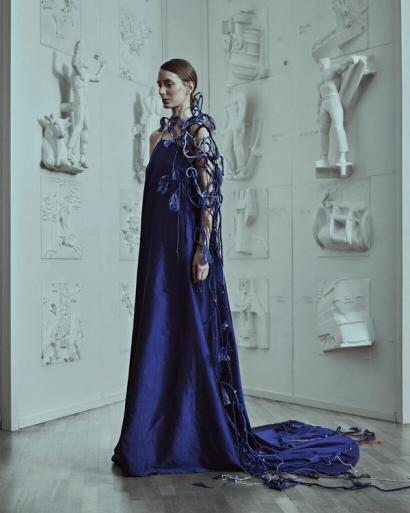
The Nobel Prize in Chemistry – “Life’s Chemical Toolkit”, interpreted by Alvaro Sanchez and Jane Elliotte Svahn
The Nobel Prize in Chemistry recognises work on proteins and is awarded to three laureates: David Baker for computational protein design, and Demis Hassabis and John Jumper for protein structure prediction.
“Our interpretation of the Chemistry Prize traces the journey of amino acids as they become proteins—the building blocks of life. Twenty different amino acids combine in various ways to form strings of beads that twist and fold into proteins. We have expressed this by creating our own organza beads in a muted palette, with touches of burgundy, cobalt, gold, amber, black and cream. The beads undergo a transformation, becoming long spiralling strands. Pleated silk organza draped across the front and back of the dress represents the way amino acids fold into proteins. Arranged in an asymmetrical spiral around the body, the string of beads guides the viewer through the formation of proteins.”
Exhibition opening hours
The exhibition is on view at the Nobel Prize Museum, Stortorget 2 in Stockholm’s Old Town, from 7 December to 7 January 2025 and from 15 February to 2 March 2025.
See the museum’s opening hours here.
Programme Director, Fashion: Pär Engsheden
Course Director: Sandra Backlund, Lecturer